

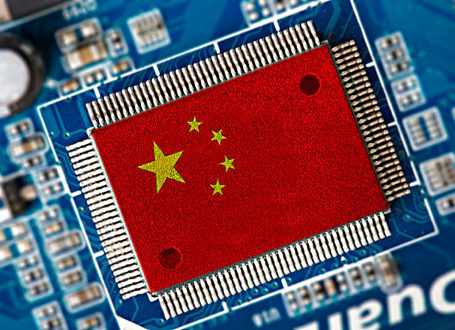
New opportunities for the development of China's chip industry
China’s semiconductor industry is witnessing a flurry of breakthroughs and significant opportunities across five key areas: foundational materials, advanced manufacturing processes, high-end chips, policy support and export markets. Below are the latest key developments:
1. Foundational Materials: World’s first breakthrough in P-type materials for two-dimensional semiconductors
Research Team: National University of Defence Technology in collaboration with the Institute of Metal Research, Chinese Academy of Sciences
Key Achievement: World’s first successful mass production of P-type two-dimensional semiconductor materials; pioneered a liquid gold/tungsten bimetallic CVD method to achieve controlled growth of single-layer WSi₂N₄ films at the wafer level
Key Metrics: Single-crystal dimensions reach sub-millimetre scale; growth rate increased by 1,000 times; hole mobility and current density are world-leading
Strategic Significance: Breaks Western embargoes on high-end chip materials, providing domestic support for foundational materials in advanced chips below 2nm and flexible electronics
II. Manufacturing Equipment: Domestic 28nm Lithography System in Mass Production; 7nm Process Yield Exceeds 80%
Equipment Breakthrough: Domestic 28nm immersion lithography system passes full-process validation and enters mass production, with a domestic component rate of **>90%**
Process Breakthrough: SMIC achieves stable mass production of 7nm chips using domestic equipment and multi-patterning, with a yield rate of **>80%** and a monthly production capacity target of 70,000 wafers
Expansion of Mature Processes: Jinghe Integrated has completed the development of its 28nm logic process; Phase IV investment of 35.5 billion yuan is being made to build a 12-inch production line, with operations set to commence by the end of 2026
III. High-End Chips: World’s Fastest ADC, 1nm Transistors, and the AI/RISC-V Boom
Ultra-High-Speed ADC
Chengdu Huamei launched the CSD10B128GA1, featuring a sampling rate of 128 billion times per second and a bandwidth of 37GHz. This is the world’s fastest mass-produced ADC, breaking the US monopoly
1nm Extreme Transistors
A Peking University team has developed a ferroelectric transistor with a physical gate length of 1nm, operating at 0.6V and reducing energy consumption by a factor of 10, thereby circumventing reliance on EUV lithography systems
AI and RISC-V
Alibaba’s玄铁 C950 is the first to natively support the Qianwen 30B large language model
CAS releases the Xiangshan open-source RISC-V processor and launches R&D for the ‘Kunming Lake’ architecture
Domestic EDA supports 3nm design, with a 30% efficiency improvement
IV. Policy and Industry: National Strategy Set, Full-Chain Collaborative R&D
Two Sessions Policy Direction (March): The Government Work Report ranks integrated circuits as the top priority among the six major emerging pillars, proposing ‘full-chain technological breakthroughs + a new national system’
14th Five-Year Plan: Clarifies the need for ‘extraordinary measures’ to achieve decisive breakthroughs in the chip sector
Financial Support: Science and technology re-lending expanded to 800 billion yuan; National Venture Capital Guidance Fund launched (China Government Network)
Application Expansion: State-owned enterprises lead the way in adopting domestic chips for power grids and 5G base stations, accelerating iteration
V. Market and Exports: Exports surged by 73% at the start of 2026, with average prices rising by 52%
Customs Data (Jan–Feb): Chip exports totalled US$43.3 billion (+72.6%), with 52.46 billion units shipped (+13.7%) and an average unit price of US$0.85 (+52%)
Growth Logic: Shift from ‘low-price, high-volume’ to high value-added products, with memory, automotive-grade and AI chips leading the way
Global Market Share: Yield rates at Yangtze Memory Technologies and Changxin Memory Technologies have improved; domestic production of mature processes is projected to reach 50% by 2025
VI. Third-Generation Semiconductors: Rapid Penetration of SiC/GaN
New Energy Vehicles: Improved yield rates and falling costs for 8-inch SiC substrates, driving adoption from high-end to mid-range models
Power Devices: Domestic automotive-grade MCUs and power chips have passed AEC-Q100/ISO 26262 certification in bulk, entering mainstream supply chains
Translated with DeepL.com (free version)
 Wechat
 Focus on us